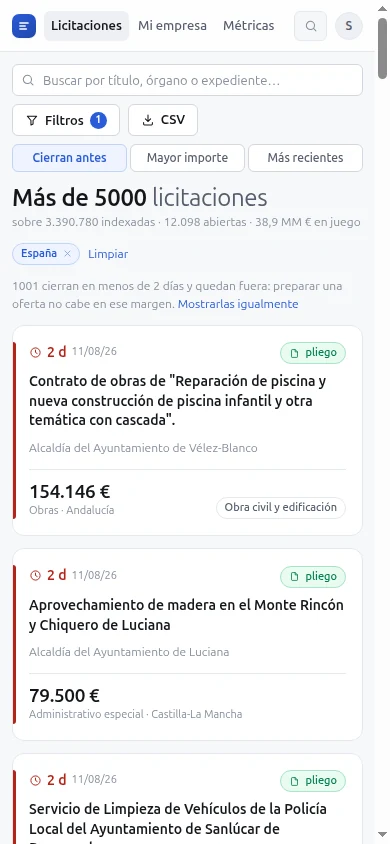
Public tenders
Analyse the tender specification, not only the notice: admissibility with the exact clause behind every conclusion.
From hundreds of pages to a decision that can be checked.
Public notices are searchable; the conditions that decide whether a company can bid are usually buried in administrative and technical specifications. The system extracts those conditions, locates each tender by CPV and connects every conclusion to its source clause.
The result is not a generic summary. It separates deadlines, solvency, classification, guarantees, award criteria and documentation, and states when the evidence is insufficient.
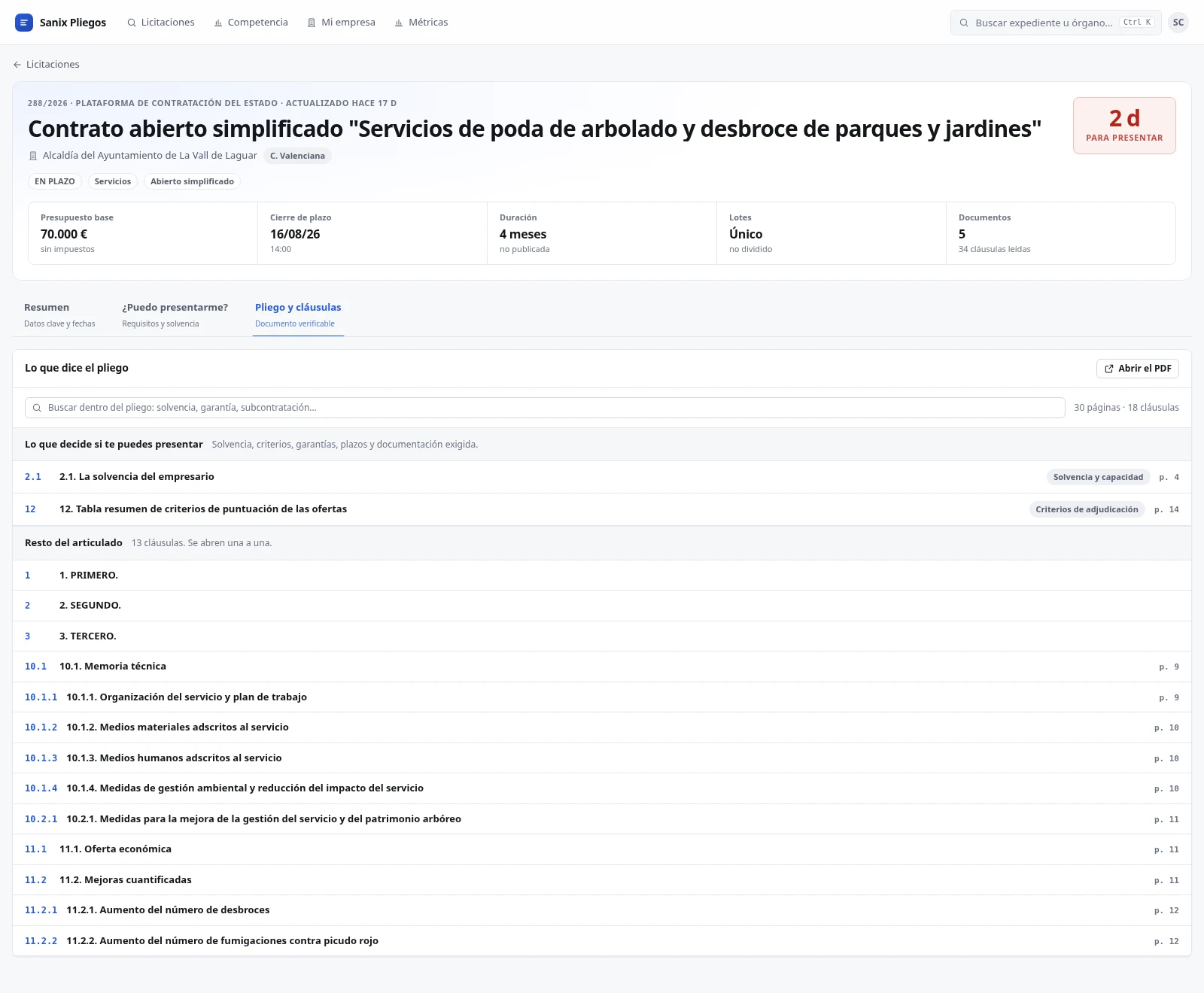
Less time filtering; more time preparing the right bid.
For the team
- Filter opportunities by company fit
- Detect disqualifying requirements early
- Track deadlines and required evidence
For the decision
- A reasoned admissibility assessment
- Direct links to the authoritative wording
- Uncertainty exposed instead of guessed away
Automation that shortens triage without hiding responsibility.
The commercial value is not “reading PDFs with AI”. It is reducing the cost of deciding where to invest bid time, while leaving a reviewable trail for the person who remains accountable.
The method transfers to regulated document workflows: extract obligations, normalise them into structured data, apply explicit rules and preserve the source behind every answer.
Document engineering, retrieval and deterministic rules.
A Python service ingests official procurement sources, normalises notices, processes tender documents and exposes structured search. Retrieval helps locate relevant passages; deterministic checks handle conditions that must not depend on generated prose.
The useful knowledge is transferable: resilient ingestion, PDF structure recovery, full-text and semantic search, citations, rule evaluation, audit trails and an interface that makes uncertainty legible.